
Nostalgia isn't a content topic. It's a psychological catalyst, and most publishers are using it wrong.
After producing thousands of articles for the 45–65 audience, here's what the data actually shows.
There's a version of this mistake I've seen over and over.
A publisher decides they want to reach an older American audience, baby boomers, Gen X, people who grew up with black-and-white TV and Saturday morning cartoons. So they commission articles about the '70s. They run listicles about forgotten sitcoms. They publish slideshows of old cars and retro supermarkets.
The traffic is okay. Sometimes good. But it never quite scales the way they expect.
The problem isn't the topic. The problem is the strategy behind it.
They're treating nostalgia as a subject matter, when nostalgia is actually a mechanism, a specific psychological state that, when triggered correctly, produces engagement that almost nothing else in digital publishing can match.
The publishers who've cracked this aren't covering the past. They're engineering a feeling.
Why this audience is different, and why it's underserved
The 45-65 demographic in the U.S. is, paradoxically, one of the most valuable and least competed-for audiences in digital content.
Most content investment in digital media chases younger audiences. The assumption is that younger readers are more valuable, more digitally native, more likely to share, more attractive to advertisers chasing long-term brand loyalty.
That assumption is wrong in at least two important ways:
First, the 45-65 audience has significantly more disposable income. They click on finance, travel, healthcare, home improvement, and consumer products at rates that younger audiences don't come close to. For publishers running content arbitrage or monetizing through display and native advertising, this audience produces better RPMs, full stop.
Second -and this is the part most publishers miss- they read. Not just skim. They follow through. A slideshow designed for this audience that earns the click on slide one will frequently hold attention through slide 25 in a way that younger audiences almost never do.
The opportunity is real. But most publishers approach it like a topic. The ones scaling it are approaching it like a craft.

What nostalgia actually does in the brain
This isn't just creative theory. There's well-documented psychology behind why nostalgia is such a powerful content driver, and understanding it changes how you build articles.
Nostalgia activates what researchers call 'autobiographical memory', memories tied to personal identity, not just events. When content triggers this, it doesn't just get the reader's attention. It connects to their sense of self. They're not reading about the past. They're reading about who they were, which is inseparable from who they are.
That produces three things that are extremely valuable for publishers:
Longer dwell time. Readers slow down. They linger on specific items. They read captions that most audiences skip.
Higher share rate. People share nostalgic content not because it's informative, because it signals something about their identity to their social network. 'This is who I am. This is where I come from.'
Comment engagement. Nostalgia triggers the impulse to validate and connect. 'I remember this.' 'My parents had one of these.' This is the engine behind the rage bait adjacent approach, not anger, but the irresistible pull to weigh in.
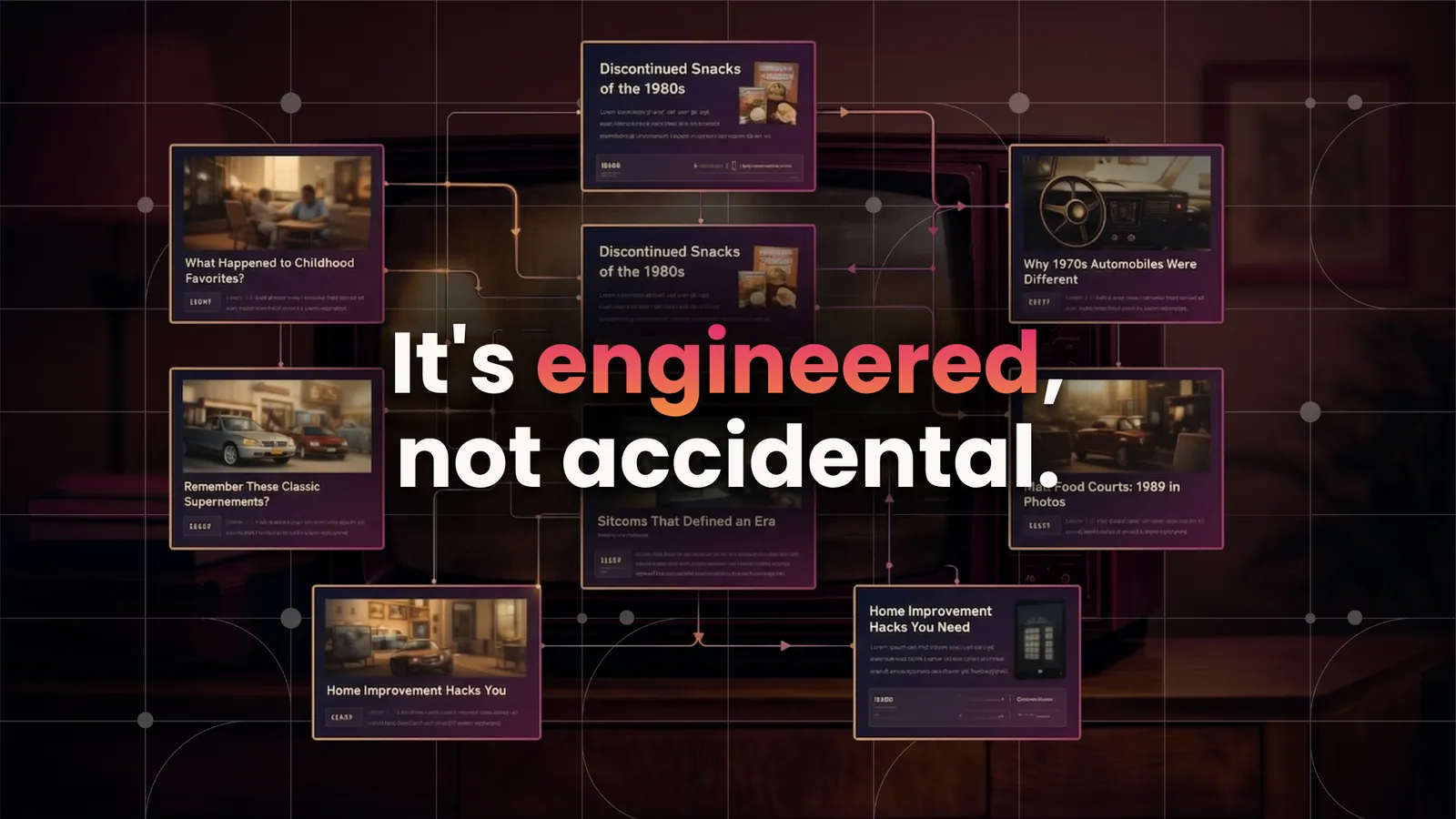
When you understand these mechanisms, the editorial decisions stop being intuitive and start being engineered.

The three elements that separate high-performing nostalgic content from average content
We've seen this play out across thousands of articles produced for different clients/partners and different platforms. The difference between a piece that gets 50K views and one that gets 1M+ isn't luck, it's usually traceable to one or more of these variables:
1. Specificity over generality
Vague nostalgia doesn't trigger the mechanism. '70s TV shows' doesn't work as well as 'Things only people who watched Saturday morning cartoons in 1978 remember.' Specificity creates the feeling of belonging, 'this is written for me.' The more precisely you identify the window of time, the cultural context, or the shared experience, the stronger the response.
2. The right gap between familiar and forgotten
Pure familiarity produces recognition but not engagement. You need the reader to feel 'I know this, but I hadn't thought about it in years.' That gap -between remembered and rediscovered- is where the emotional payoff lives. Articles that are too obvious ('30 Things Everyone From the '80s Remembers') underdeliver because there's no rediscovery. Articles that are too obscure miss the audience entirely.
3. Image selection as editorial decision
For this audience, the image is often more important than the headline. A specific photograph, the packaging of a discontinued product, the interior of a car from 1974, a mall food court from 1989, can trigger the emotional response before the text ever does. This means image curation isn't a production task. It's an editorial task. The wrong image breaks the spell entirely.
The teams producing the best nostalgic content at scale treat every image choice as a creative decision, not a production checkbox.
What scale looks like when you get it right
I'll share a data point from one of the operations we run.
One of our copywriter teams producing nostalgia-focused gallery content for a U.S. publisher hit over one million views across their articles in a four-day period. Not one viral piece, a consistent output of pieces that each performed above benchmark.
The articles weren't longer or more researched than average. The team wasn't larger. What was different was the systematic application of the principles above: specific angle, precise audience identification, image-first editorial thinking, and titles engineered to trigger the 'I remember this' response rather than just describe a topic.
1M+ views in 4 days - produced by a lean team applying consistent editorial principles, not chasing viral luck. That's not a one-off. It's what happens when you stop treating nostalgia as a topic and start treating it as a production methodology.
That means:
Building editorial frameworks, not just article calendars. What specific time windows? What categories of experience? What emotional register, warmth, humor, identity?
Investing in image sourcing as a core competency. Not stock photos. Real, era-specific, emotionally resonant images.
Testing titles as systematically as paid media teams test headlines. The angle determines the performance ceiling. The title either triggers the mechanism or it doesn't.
Do those three things consistently, and the nostalgia vertical becomes one of the most predictable traffic engines in your editorial portfolio.
Milan Lab builds and operates editorial, content, and software teams for digital publishers and media companies. See how we work.
Working through this in your own operation?
It's the kind of problem we build teams to solve.
See how we work