
The Myth of Evergreen Content: Is your content library silently rotting?
Evergreen content doesn't exist.
What you have is a library that's quietly decaying, and most publishers don't notice until it's too late.
The most dangerous content problem isn't what you haven't published yet. It's what you published years ago and stopped thinking about.
I've had a version of this conversation more than I'd like to count.
A publisher reaches out. They've been in the game for years. Built a solid content library, hundreds, sometimes thousands of articles covering their core topics. Real investment. Keyword research, solid structure, internal linking, optimized metadata. They did it right.
And then, somewhere between two and four years later, the traffic starts dropping. Slowly at first. Then faster. They assume it's an algorithm update. They commission new content. The numbers keep declining.
When we dig in, the answer is almost always the same.
Their evergreen content stopped being evergreen. And nobody was watching.
The content didn't fail because it was bad. It failed because the world kept moving, and the content stayed exactly where it was.

The myth that made sense, until it didn't.
The idea of evergreen content is genuinely seductive. Write it once, rank forever. Timeless topics, durable value, compounding returns over time. It's the dream of every publisher, content as a long-term asset, not a perishable good.
And honestly? It's not a wrong idea. It's an incomplete one.
Here's what actually happens. You publish a well-researched article. It ranks. It performs. It becomes part of your core traffic base. And then, gradually, invisibly, it starts to age.
The statistics you cited get outdated. The tools you recommended get replaced. The regulations you referenced change. The market context shifts. Google updates its quality signals.
None of this comes with a notification. There's no alert that says 'your evergreen content is now out of date.' The traffic just quietly erodes, often so slowly that publishers don't connect cause and effect until the damage is already significant.
Evergreen isn't a content category. It's a decay rate. And every piece of content, no matter how well-built, has one.

But there's a second problem. And it's sneakier than the first.
Context changes. We all understand that. The world moves, information shifts, yesterday's data becomes today's fiction. That part is obvious once you think about it.
What's less obvious, and in some ways more damaging, is what happens to your content on the internet while you're not looking.
It gets read. Absorbed. And replicated.
That article you published in 2021? Someone read it, internalized the structure, and published their own version six months later. Then someone else did. Then five more. By 2024, the core argument you made, the one that felt fresh and specific when you wrote it, has become background noise. The reader has seen it before. Multiple times. From multiple sources. In slightly different words.
This is the free replication problem of the open internet. Everything is visible to everyone. Good ideas spread, and once they spread, they stop feeling like insights and start feeling like common knowledge.
The result: your article doesn't just feel old because the data has aged. It feels old because the idea aged. The reader has already been through this argument, even if they never specifically read your version of it.
Your content can become invisible not because it got worse, but because the internet got more crowded around it.
This is a fundamentally different kind of decay than factual obsolescence, and it requires a different response. Updating the statistics won't fix it. Reconsidering the angle might.
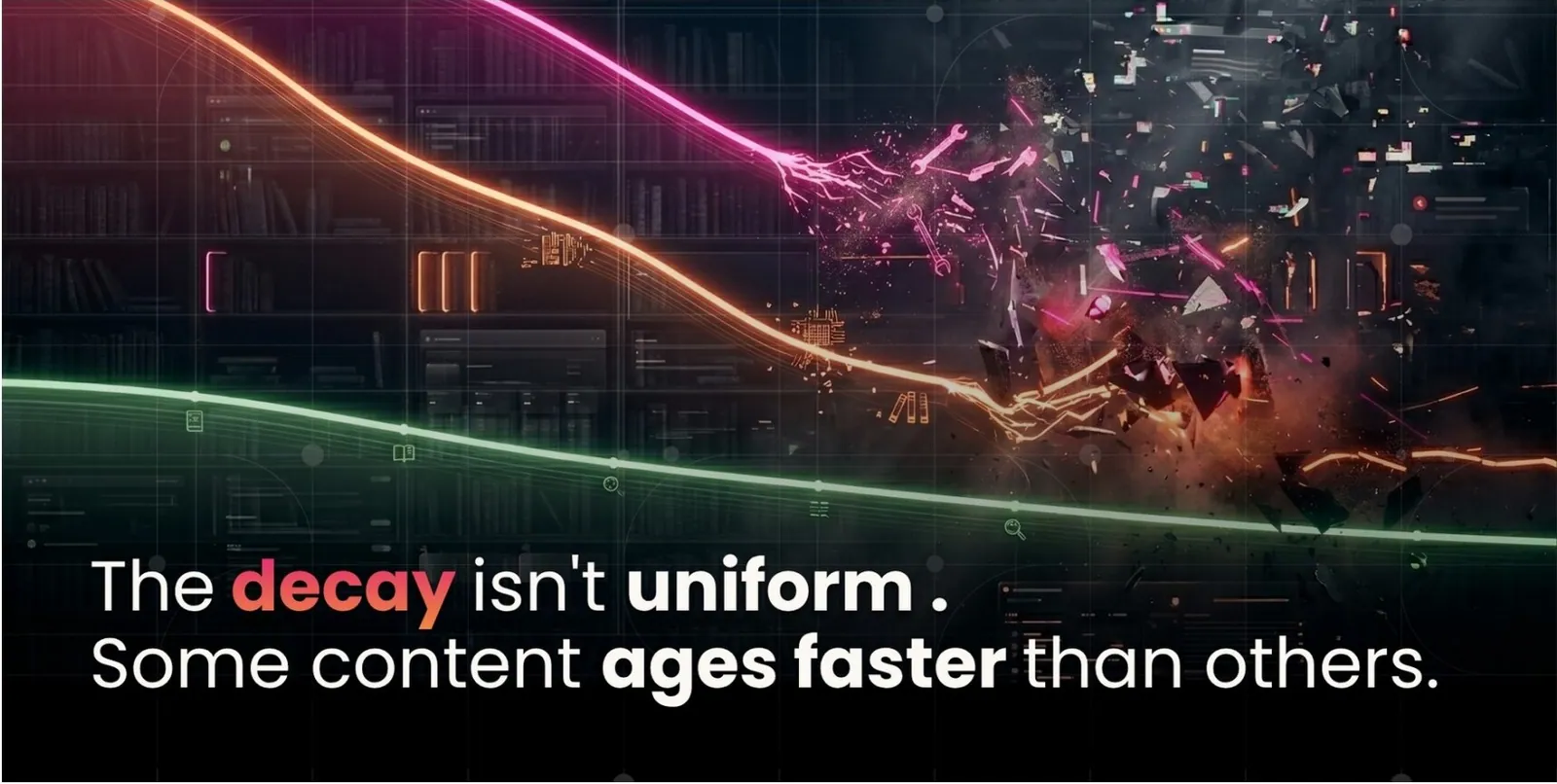
The decay curve most publishers aren't tracking.
Think of every piece of content as having a half-life, a point at which its relevance, accuracy, and competitive strength has been cut in half from its peak.
For news content, the half-life is days or weeks. Everyone gets this. Nobody expects a product launch story to perform indefinitely. For evergreen content, the half-life is longer. But it exists. And the mistake is treating 'longer half-life' as 'no half-life.'
The decay isn't uniform either. Some content ages faster than others:
Understanding your content library's decay profile is the first step toward managing it as an asset, rather than watching it quietly become a liability.
The silent cost most publishers underestimate.
There's the obvious cost: lost traffic, lost rankings, lost revenue. Publishers understand this part, even if they don't act on it fast enough.
What they miss is the subtler cost: authority erosion.
When a reader lands on your article about industry trends and the data is three years old, they don't just leave. They leave with a slightly weaker impression of your brand. At scale, an aging content library doesn't just underperform, it actively undermines the credibility you're building with every new piece you publish.
And when that aging content also happens to be a repackaged version of an idea that's been circulating for years? The authority damage compounds. You stop being a source. You become an echo.
2-3 years is the average window before data-heavy 'evergreen' content starts producing measurable authority damage, not just traffic loss.
The publishers who understand this stop treating content maintenance as a cost center. They treat it as editorial infrastructure, as important as new production, not secondary to it.

What maintenance actually looks like in practice.
Content maintenance isn't rereading every article every year. That's not scalable and not strategic. The publishers doing this well have systematic processes that triage their library and prioritize interventions based on impact.
The framework that works consistently has three layers:
The publishers who win long-term aren't the ones who publish the most. They're the ones who maintain the best, and who know when to update versus when to completely rethink.
From content library to content portfolio.
A library is a collection of things you've accumulated. You add to it. You occasionally browse it. You don't actively manage it as a performance system.
A portfolio is different. Every asset has a performance expectation. You track it. You intervene when it underperforms. You double down when it overperforms. You retire assets that can't be recovered, or that have been so thoroughly replicated that rebuilding them from scratch is the only way to reclaim authority.
Publishers who think in terms of a library measure success by volume: how many articles do we have? Publishers who think in terms of a portfolio measure success by yield: how much value is each piece generating, and is that value growing, stable, or declining?
The shift changes how you allocate resources. It changes what you track. It changes when you commission new content versus when you invest in what you already have.
And it changes one more thing, what you consider a publishing risk. Right now, most publishers think the risk is in the content they haven't made yet. The ones who've learned this lesson the hard way know the real risk is in the content they made years ago, filed under 'done' and forgot about entirely.
One last thought before you close this tab.
You started reading this article a few minutes ago. By the time you finish -if you haven't already- at least one statistic somewhere in the industry will have shifted. Some tools will have updated its pricing. Someone, right now, is publishing their own take on exactly this topic.
That's not a reason to panic. It's a reason to pay attention.
The publishers who treat their content library as a living system -something that needs tending, not just adding- are the ones still generating returns from work they did three years ago.
The ones who don't?...
Milan Lab builds and operates editorial, content, and software teams for digital publishers and media companies. See how we work.
#ContentStrategy #DigitalPublishing #SEO #EditorialOperations #EvergreenContent #ContentMarketing
Working through this in your own operation?
It's the kind of problem we build teams to solve.
See how we work