
In the age of hyperpersonalized content, single-format publishing is quietly disappearing.
In the age of hyperpersonalized content, single-format publishing is quietly disappearing.
And the publishers still doing it don't see it yet.
Why producing your content in a single format is quietly limiting who you reach, and quietly limiting how they think about what you publish, in a content economy that has moved on from anyone who hasn't.
One of the things I find most interesting about how we work at Milan Lab is that on any given week we're producing the same idea in formats that don't talk to each other on paper: a long article for one site, a Snapchat short for another, an Outbrain native ad for a third, a Reddit post somewhere else, a YouTube essay, a vertical video for TikTok, a search content piece designed to capture intent on Google. Different teams, different surfaces, different audiences. Same underlying idea.
It took me a while to understand why this matters as much as it does. Most publishers treat format the way they treat packaging: the last step in a content workflow, the thing the team does after the substance is done. From inside that frame, multiformat looks like a distribution exercise. You make the content, then you cut it up and push it out everywhere.
In practice, format is closer to the opposite. It's the first decision that determines whether someone gets to experience your content at all. And then it does something else, something even more important, which most publishers don't see until they've been running multiformat operations for years: format shapes what the reader actually takes away from your work.
> Format isn't how your content travels. It's who gets to find it, and how they remember it after.
Each format produces different knowledge in the reader's head.
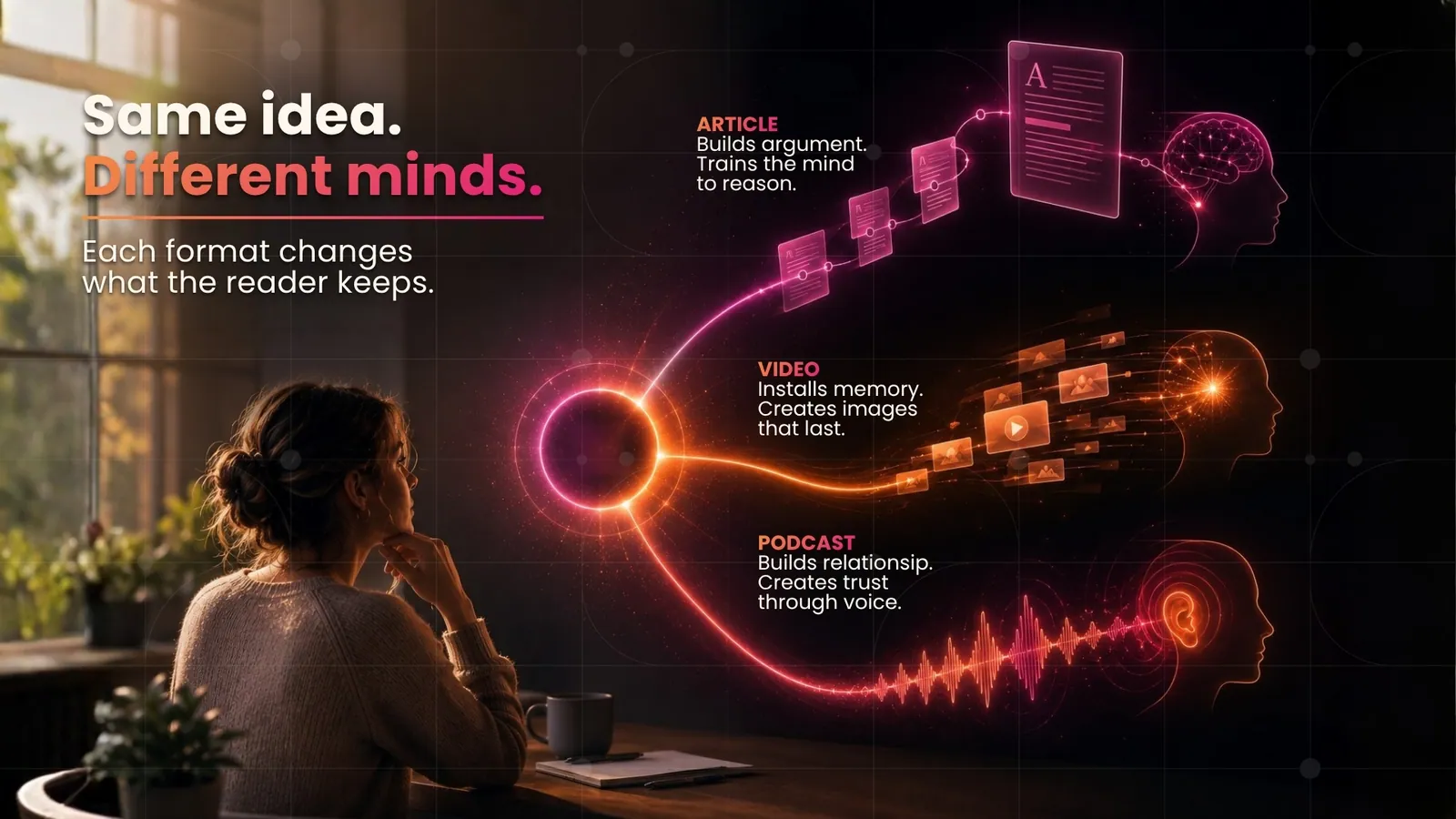
This is the part most publishers don't fully internalize, and it changes everything once you do. The same content delivered in different formats doesn't just reach different people, it produces fundamentally different cognitive outcomes in the people who consume it.
When someone reads a 1,200-word article on a topic, they build an argument in their head. They follow a chain of reasoning, they sit with the structure of the piece, they finish with an opinion shaped by the way the writer led them through it. The format itself is doing work, training the reader to think about the topic as something that can be reasoned through carefully.
When someone watches a 60-second video on the same topic, none of that happens. What they walk away with is a feeling, an image, a memorable moment, a single point that lodges itself somewhere in long-term memory. The video isn't a faster version of the article, it's a different product that does a different job in the brain: it installs memory rather than building argument. When someone listens to a 30-minute podcast on the same topic, something else happens entirely. They develop a relationship with the voice. They feel like they've spent time with a person, not just consumed information. The trust they build is with the host, not with the content.
This means a publisher running a single format isn't just limiting access to one audience profile. They're limiting the cognitive footprint of their work to one mode of thinking. The reader who would have built an argument never gets the article. The reader who would have absorbed the memorable point never gets the video. The reader who would have come to trust the voice never gets the podcast. Their good content exists in one dimension when it could be operating in three.
The publishers who scale beyond a certain point figure out that producing the same idea across multiple formats isn't repetition. It's architecture. The reader who finds the short clip on TikTok, comes back for the article, and eventually subscribes to the podcast isn't three audiences, it's one reader being given three different ways to deepen their relationship with the work. Each format reinforces the others, and the whole becomes much more durable than any single piece could be.
> The same content in three formats isn't the same content tripled. It's three different experiences of the same idea, and each one builds a different kind of trust.
Why this matters more now than it did even five years ago.
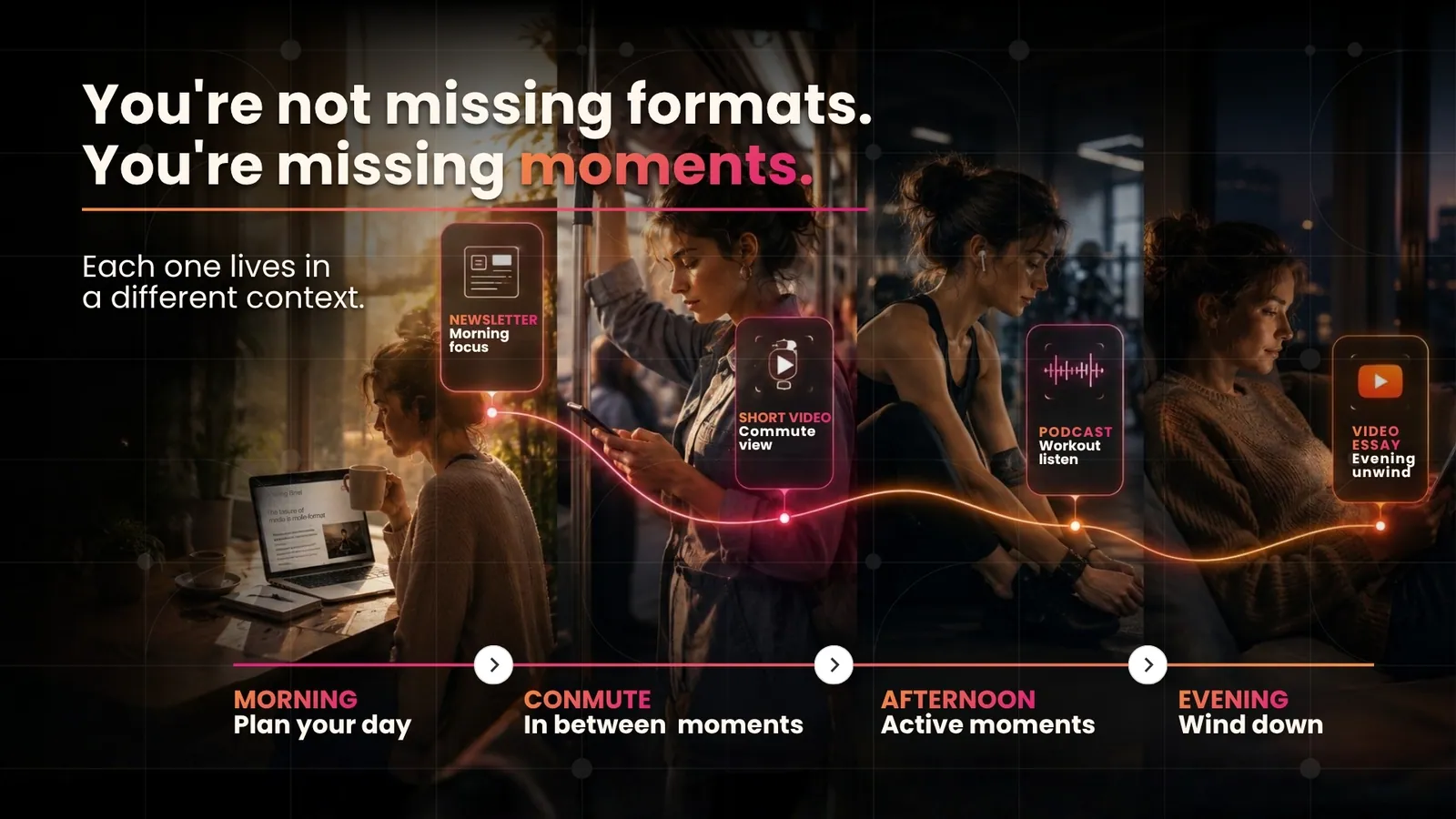
There's been a structural shift in how people consume information that most publishing strategies haven't caught up to. Five years ago, you could reasonably build a media operation around two or three dominant formats and reach most of your potential audience. Articles, video, podcast, maybe a newsletter. That covered the field.
Now the field has fragmented into dozens of formats, each one optimized for a specific moment, device, and mental state. Short-form vertical video covers the commute, long-form podcast covers the gym, carousel posts handle the scroll, newsletters take the morning coffee, YouTube essays land in the evening, TikTok and Snapchat fill the in-between moments, Outbrain native ads sit inside the content sites where people already spend hours of their day, Reddit threads pull entire communities into deep discussion in their own language, and search content captures intent at the exact moment someone is looking for an answer on Google. Each one has its own audience, its own algorithm, its own cultural conventions, its own way of being read, and ignoring any of them means leaving an audience invisible to your work.
And the platforms have started rewarding format fluency more than they reward content quality. An article that would have ranked organically five years ago now needs a video companion to surface in search results. A podcast that depended on iTunes discovery now needs short clips on YouTube, Instagram, Snapchat, and TikTok to find new listeners. A great essay shared as a paragraph of text on social will lose to a mediocre essay turned into a 30-second hook video. Outbrain rewards thumbnails and headlines that work for a very specific kind of scroll. Reddit rewards format conventions that feel native to each subreddit. The algorithms aren't asking whether your content is good, they're asking whether it's in the format that performs on their surface, and what counts as the right format changes from one surface to the next.
This is the era of hyperpersonalized consumption, where every user has a different feed shaped by a different set of preferences, and the only way to be present across those feeds is to exist in the formats each one rewards. The publishers still producing in one dominant format are competing with one hand tied behind their back, not because their content is worse, but because most of their potential audience never even gets the chance to find out.
Why doing this well is harder than it looks.
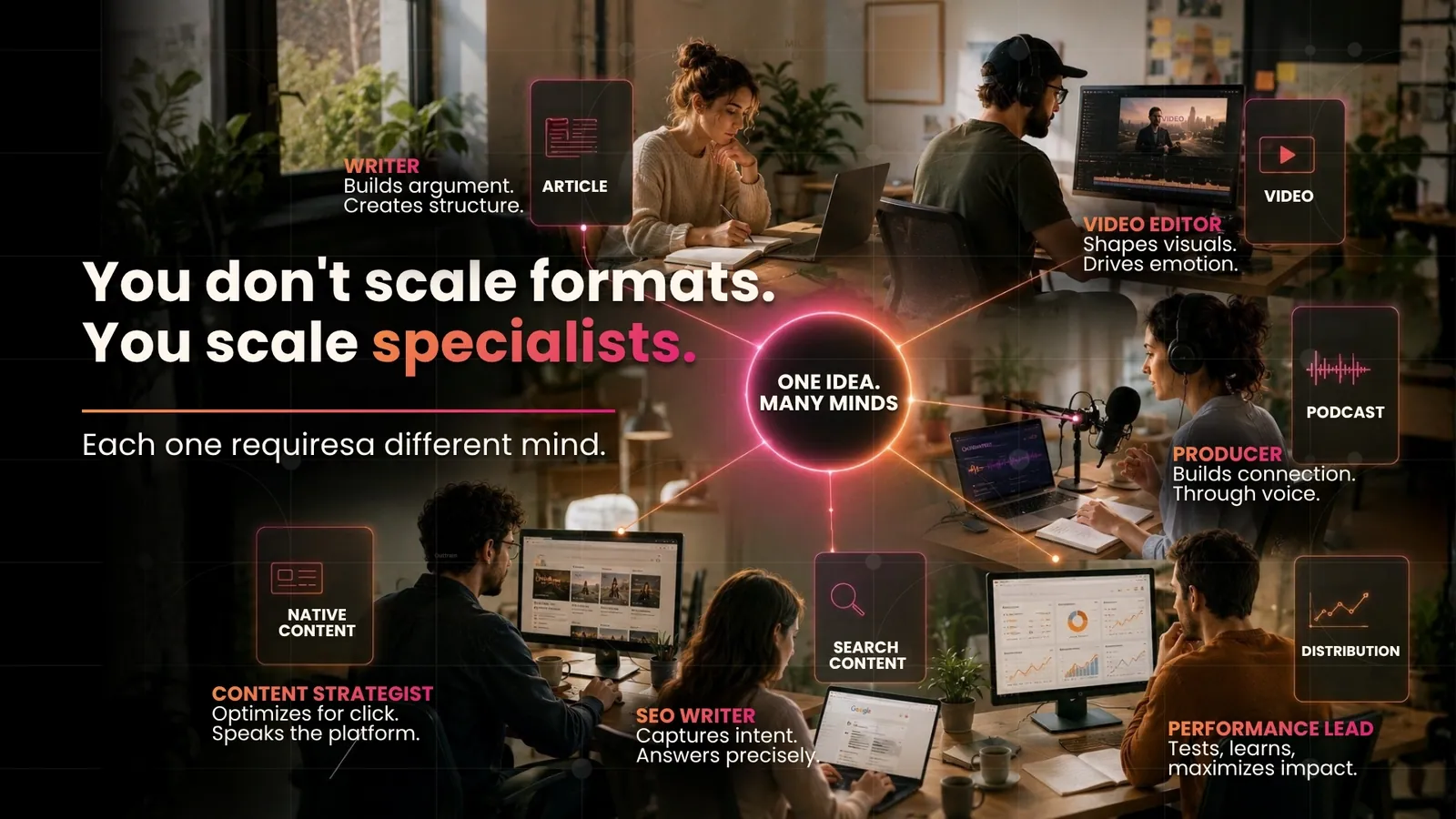
If multi-format publishing were just a matter of cutting articles into video clips and reposting them, every publisher would already be doing it. The reason most still aren't is that doing it well requires treating each format as its own product, with its own talent, its own metrics, and its own editorial logic, and that level of investment is much higher than most operations are structured to absorb.
A great article writer is rarely a great video script writer. A great video editor is rarely a great podcast producer. The skill sets overlap in surface ways but diverge sharply in the details, and a publisher that tries to convert their existing editorial team into a multi-format operation usually ends up producing competent versions of everything and excellent versions of nothing. The format that the team is native to keeps its quality, and everything else looks like a downgraded translation.
This is why we built dedicated teams at Milan Lab for each format we work with, instead of trying to stretch a single editorial team across all of them. There's a video team producing thirty to forty pieces a week across YouTube, Snapchat, TikTok, and Facebook, each one with its own native conventions. There's a separate team handling Outbrain and other native content surfaces, where the editorial logic of headlines and thumbnails is closer to direct response than to journalism. There's a search content team building pieces designed to capture intent at the exact moment people are searching. There are copywriters producing long-form articles, listicles, slideshows, and SEO content for partner sites and MSN syndication. Each team has its own supervisor, its own production rhythm, its own quality standards, and works in coordination with the others rather than as an extension of any single editorial workflow.
It's more expensive to operate this way, and it's significantly more difficult to scale, but the alternative is producing multiformat content that quietly tells the audience the format wasn't taken seriously. Readers, especially in 2026, can tell the difference. A video that was clearly cut from an article reads as a video that was clearly cut from an article, and the audience that prefers video closes the tab. Same with a native ad that was written by someone who doesn't understand how Outbrain works, or a Reddit post that sounds like marketing copy translated into a forum tone. The format isn't fooled, and the audience isn't either.
None of this means every publisher needs to be in every format. Some operations are deliberately built around a single format and a single audience, and that's a perfectly reasonable strategy when it's chosen on purpose. The mistake is defaulting into a single format because that's what the team knows how to do, while assuming the audience that doesn't show up just isn't interested. They might be very interested, in the format you haven't produced for them yet.
The vertical series moment, and why most publishers are getting it wrong.
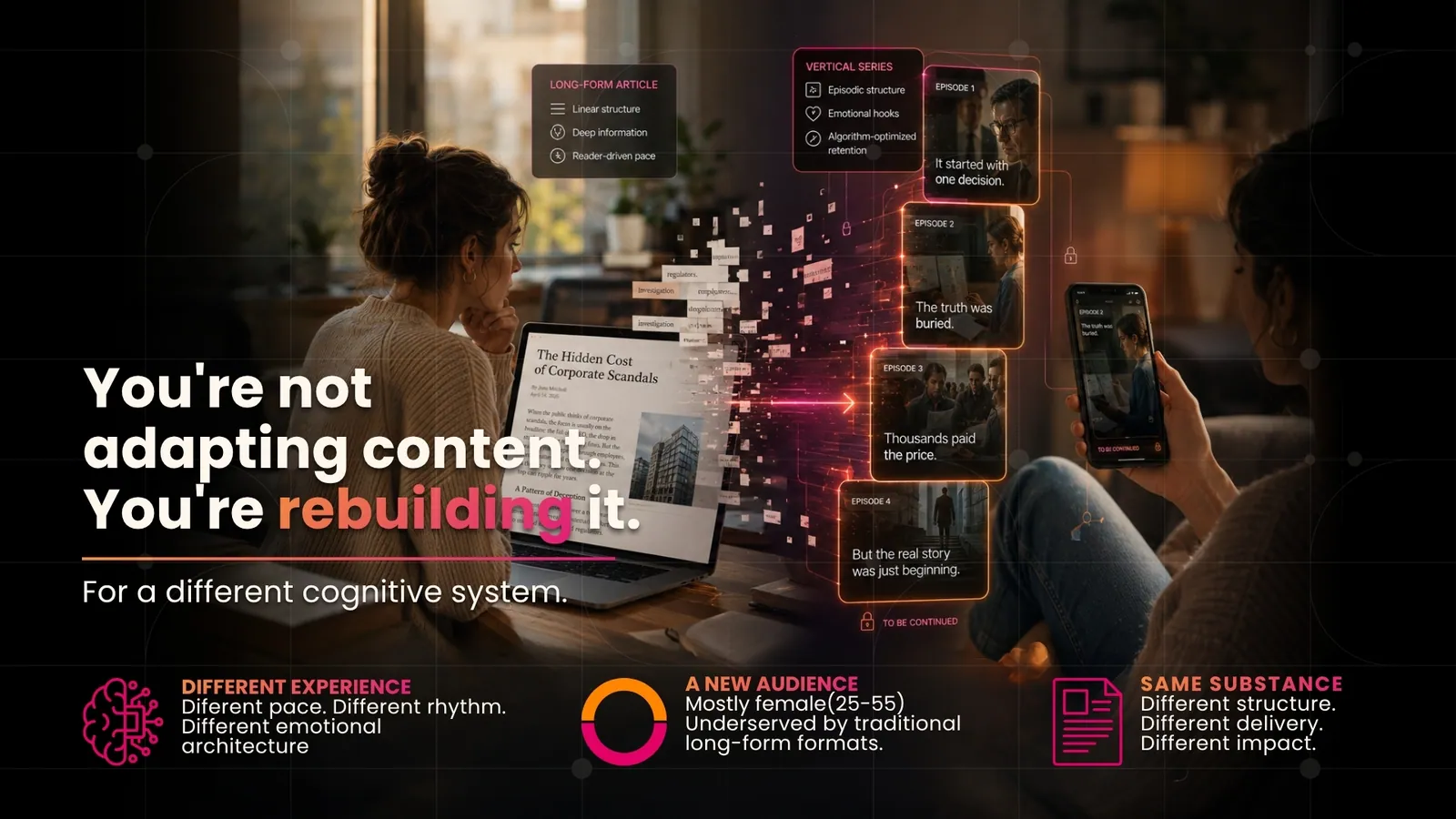
There's a format that exploded in the last eighteen months and is rewriting what we thought we knew about how people consume long-form content: the vertical series. Episodes of thirty to ninety seconds, shot vertically, structured around cliffhangers, released in sequence on dedicated platforms like ReelShort, DramaBox, GoodShort, and increasingly inside the discovery feeds of TikTok, Snapchat, and Instagram. Platforms built around this format are doing hundreds of millions of dollars in annual revenue, with audiences that don't overlap with traditional long-form video at all.
Most of the publishers entering this space either dismiss vertical series as a passing trend or treat them as longer TikToks, which is the same mistake in two different costumes. Vertical series aren't a social media format, they're a new category of editorial product. The narrative is serialized, the pacing is engineered around retention windows that the algorithms reward, the writing is closer to soap opera structure than to documentary or essay, and the audience consumption pattern looks more like Netflix bingeing than like scrolling. The publishers treating this as one more thing to cut into pieces from existing content are producing the worst possible version of it, and the algorithms know.
The interesting opportunity, and this is what very few publishers have figured out yet, is that a long-form article or a deeply reported feature can be reimagined as a vertical series in a way that captures a demographic that was never going to read the original. A thousand-word reported piece about, say, a corporate scandal or a family drama or a true crime story isn't translated into a vertical series. It's rebuilt for a different cognitive architecture: shorter beats, sharper hooks, episodic structure with a payoff designed to land at the end of every chapter. The substance is the same, but the product is a different one, and the audience that finds it through the vertical surface is mostly female, mostly between twenty-five and fifty-five, and mostly invisible to the operations producing the same content as a long-form article and assuming everyone interested has read it already.
This is the strongest example I can think of right now of the principle I've been describing through this entire piece. Vertical series aren't a distribution channel. They're not a way to repurpose existing content into something smaller. They're a different format that produces a different cognitive experience for a different audience, and the publishers who treat them with the same seriousness they bring to their long-form work are quietly capturing one of the fastest-growing audience segments in digital media right now. The publishers who are dismissing them or doing them badly are going to look back in two years and wonder why everyone else was already there.
They didn't miss your content. You missed them.
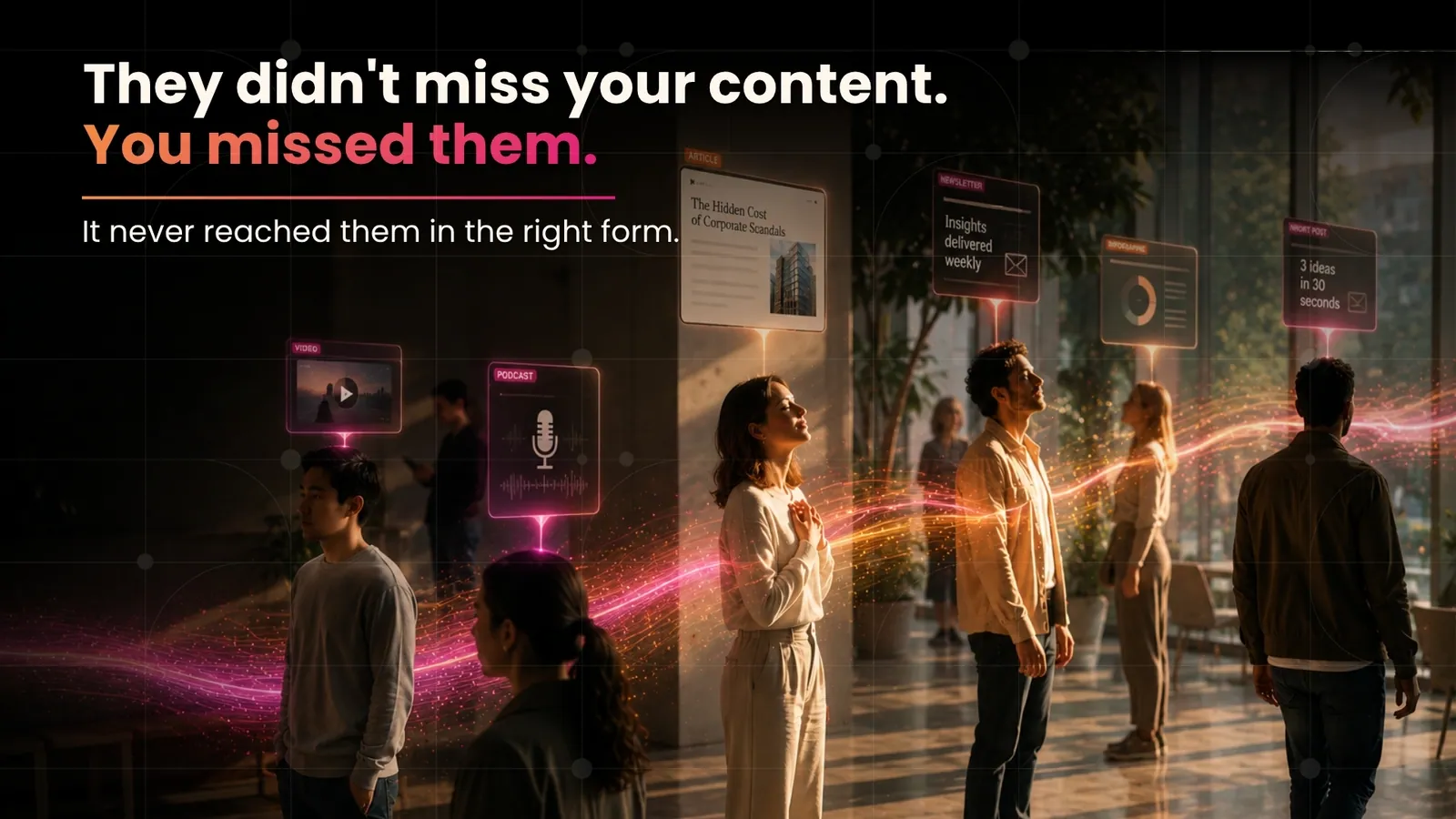
So here's the question I'd leave any publisher with.
Pick one of your best pieces from the last year, the one you're proudest of, the one that performed well by your standards. Now ask yourself how many of the people who would have loved it never got to find it, because they don't read articles, or they don't watch videos, or they don't listen to podcasts, or whichever format you didn't make.
That's the audience you're not reaching. Not because your content isn't good enough for them, but because you never gave it to them in a shape they could receive.
Milan Lab builds and operates editorial, content, and software teams for digital publishers and media companies. See how we work.
#DigitalPublishing #ContentStrategy #MultiformatContent #EditorialOperations #VideoContent #MediaBusiness
Working through this in your own operation?
It's the kind of problem we build teams to solve.
See how we work