
Publish rate is the first number I stopped trusting.
Every syndication dashboard leads with the same figure, and it's the one I trust least. Publish rate: the percentage of what you submit that actually goes live. It sits there north of 96 percent, often brushing 100, looking like a clean bill of health. Early on I read it the way it's built to be read. If almost everything I send goes live, the operation must be fine.
The problem with that number is that a thermometer was never built to diagnose you, it's built to tell you you're fine. Publish rate is the platform's thermometer, and a normal temperature has talked more operations into complacency than any other metric in this business.
Publish rate measures exactly one moment: acceptance at submission. The piece has its required fields, it clears the first filter, it enters the queue, and it goes live. Everything that number knows about your content, it knew at the door. What it doesn't know is everything the platform does to your content after it publishes, which is where the real diagnosis happens.
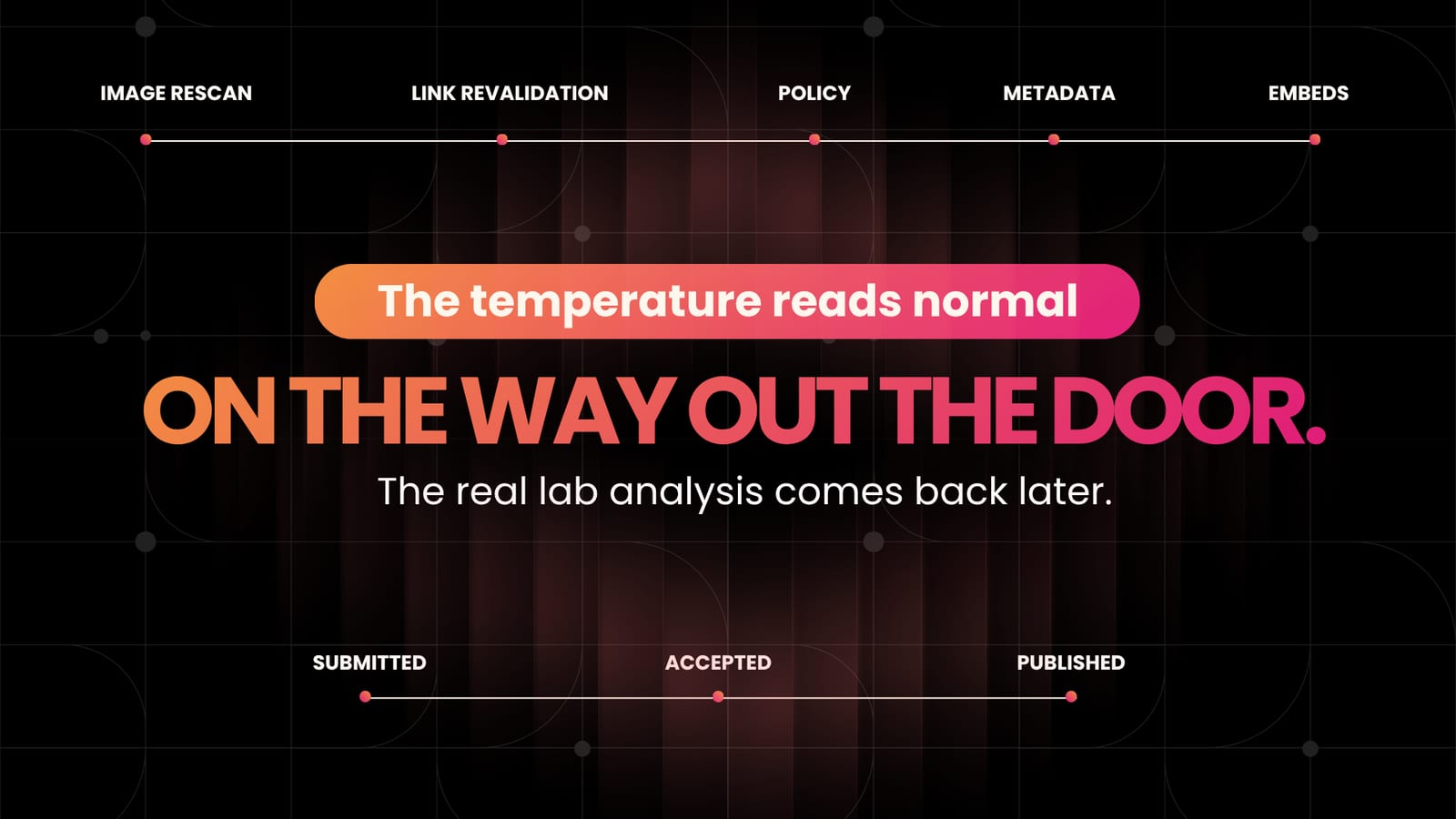
The real lab analysis comes back later.
As you may now know, the platform runs a full panel after you've left the room. It rescans images, revalidates the links and media inside the piece, runs moderation on policy, metadata, and embeds. None of that happens at publish, it runs hours to weeks later on content that is already counted as a success, so none of it ever touches your publish rate. The temperature reads normal on the way out the door. The real lab analysis comes back later, and it is what the platform actually uses to decide whether the account keeps its standing.
Nowadays you're watching a number designed to reassure while the diagnostic that matters runs out of sight, on a delay. So accounts fail the way a person with a perfect temperature and bad labs fails: symptom-free right up until they aren't, for reasons the dashboard swears aren't there.
The number most operations never run.
Do you want to know the number most operations never run because it's the one that would scare them? Reruns. Converting an old slideshow into an article and shipping it again is the cheapest inventory in syndication, and at scale it's a large share of what goes out. Guess what, an old asset carries its original chart with it. Images with text, a caption, or a source watermark baked into the pixels, which a scanner now reads as a violation. Media links that were alive when the piece first ran and have died since. Embeds from services that changed their rules years ago. All of those were latent flags today, but they were all clean on the day they were first published.
Do the arithmetic, because it isn't a rounding error. Take a rerun batch of a few thousand pieces. If even two or three percent carry one dead media link or one image with text burned in, that's over a hundred latent violations sitting in your queue with a clean temperature on top of them. Of course, the platform doesn't meter them out politely. It finds them on its own pass and collects them in a batch. Two days apart, an account and a stack of one hundred flags arriving on the same afternoon are the same account.
A throttle is a flag. An account action is a diagnosis.
There's a category error stacked on top of all this, and it's worth naming because it decides how you respond. A throttle is a flag on a result: the platform showing less of you, recoverable, and often reversible in days. An account action is a diagnosis: a categorical call about the account, with a longer and less certain way back. Read the first as a bad week and wait it out, and you can miss the window where it was still a flag and not yet the diagnosis.
So the discipline we run is built entirely around the layer the thermometer can't see. Three habits carry most of it.
We track what happens to content after it publishes. Flags, takedowns, and downranks that land days later get logged and watched as their own stream, separate from acceptance. Acceptance is the intake form.
We treat recycled inventory as its own risk pool. Before old content goes back out, it gets the same workup as new: images cleared of burned-in text and logos, links and media revalidated, and embeds checked against current policy. That debt is cheap to clear on the way in and expensive to find on the way out, and clearing it pays back more than almost anything else an operation running reruns at scale can do.
We read a sudden, dateable drop as a possible category change. When performance breaks on a specific day and the damage concentrates in the newest content, that's the signature of a pipeline or policy change. The two look nothing alike once you know to separate them, and they call for opposite moves. One you wait out, the other you treat now.

None of this shows up if you're grading yourself on publish rate, and that's the uncomfortable part, because the thermometer is the number that feels good. A healthy account and one in real trouble can post the same publish rate right up to the end, because that number was never measuring the thing that ends them.
I've written before about the approval layer being where the margin actually gets decided. This is the same terrain from the other side. That piece was about the money you win or lose inside the rules. This one is about the visibility you don't have into your own body of work. A healthy publication isn't the one with the best temperature. It's the one drawing its own sample before the platform draws it for them.
Milan Lab builds and operates editorial, content, and software teams for digital publishers and media companies. See how we work.
Working through this in your own operation?
It's the kind of problem we build teams to solve.
See how we work