
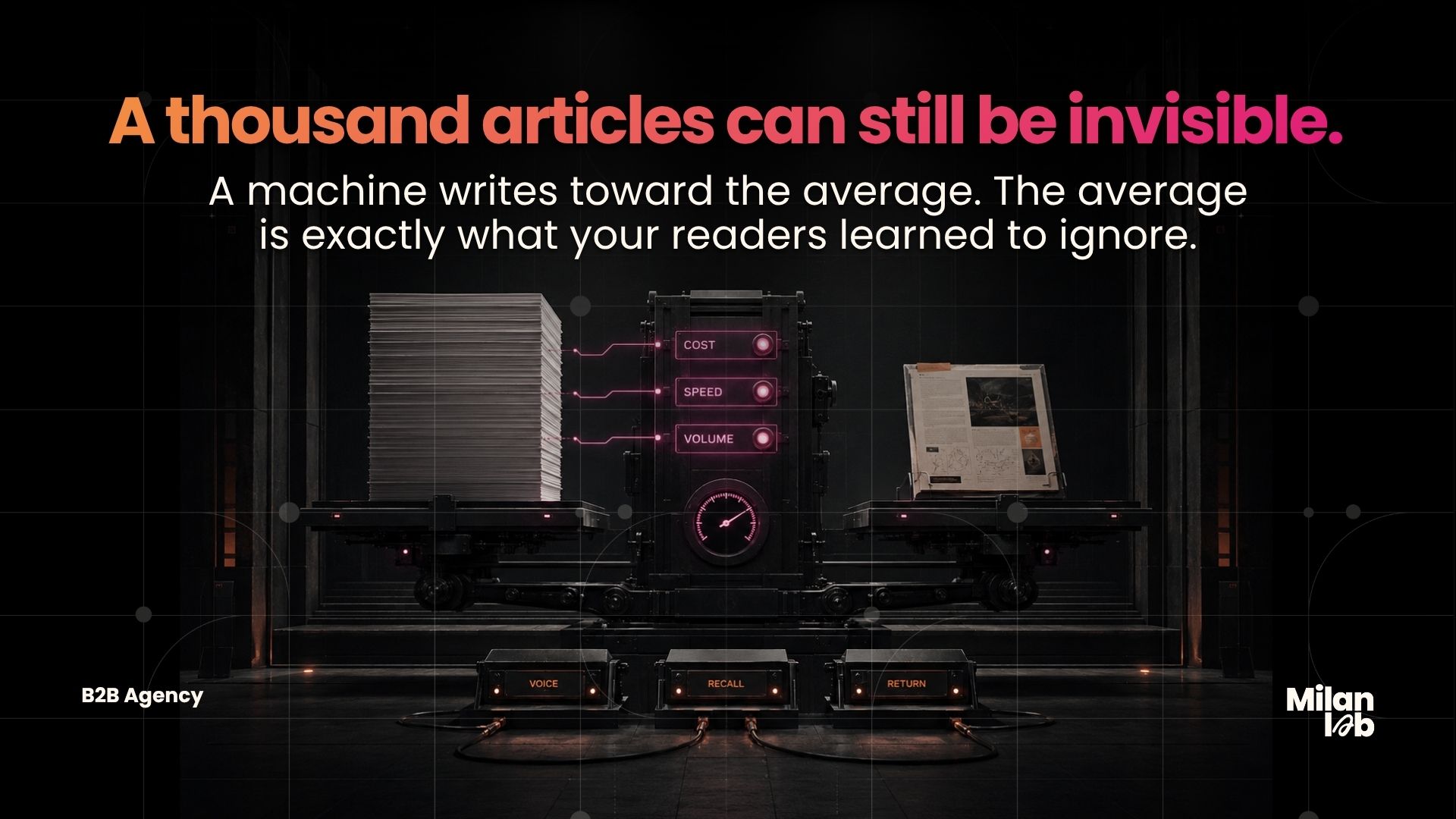
A thousand articles can still be invisible.
On cost per article, I lose to the machine every time.
A founder I like put it to me straight a few months ago. He runs a lean content operation. He'd just watched a competitor spin up a thousand articles in a weekend for the price of a nice dinner, and he wanted to know how a business built on actual people survives that math. It really was an honest question. He was deciding where to put his next dollar, and he wanted me to talk him out of the obvious answer.
I didn't argue about the math, because mathematically he's right. Line us up against a generation model, score it on cost per published word, and we lose. I told him that to his face. I told him he was keeping score on the wrong number, and that I've bet the shape of my company on it being the wrong number.
Here's the bet, and here's why I keep making it even though it's the more expensive one to make.
A partner we signed a few months back already came back asking to grow the account. His pieces were some of the best-performing things his company published all year. A couple of them broke internal records that had stood for a while. Nothing about that came from us writing faster or cheaper than a machine. It came from one thing that's easy to say and hard to staff: we write in his voice, not a competent version of it, the actual one.

The account grew because the content sounded like the person behind it.
That distinction is the whole argument, so let me be exact about the mechanism, because "we get the voice right" sounds like the softest claim in marketing.
A voice is a set of deliberate deviations from the average way a thing could be said: what a publication refuses to say, the rhythm its readers recognize before they've registered the byline, the joke it would make, and the one it wouldn't. When you train a model on the whole internet and ask it to write, it doesn't reach for those deviations. It reaches for the center of the distribution, because the center is what it's optimized to predict. It gives you the mean: fluent, clean, and average by construction.

Prediction pulls toward the middle. Voice lives at the edges.
The mean is exactly what a real audience has learned to ignore. People build a habit around a specific voice that feels like it belongs to them, and belonging is made of the deviations.
So when we put a writer who actually lives in a given register on an account, what the partner is paying for isn't the words per hour. It's someone holding the specific deviation his readers recognize as his. We keep people who can write like a market's desk, people who can write like a brand a soccer mom trusts, and people who can write comedy that lands. The one who nails the market's voice would flatten the comedy, and the comedy writer would sound wrong in a compliance-heavy financial piece. That range is expensive to keep on the bench. It's also the part a model can't fake, because faking it means deviating from the mean on purpose, toward one specific target, and staying there for eight hundred words.
Now the part that made me comfortable making the expensive bet instead of the cheap one.
The market is moving toward me, not away. Syndication platforms and the places that distribute this content at scale are pulling back from generated work, tightening the rules on it, and downranking the obvious cases. Readers spot the tells in about a minute. Some writers have started dropping small imperfections into their work on purpose, a slightly informal turn or a deliberate roughness, as a signal that a person was here. When people start hand-signing their work to prove it wasn't automated, you're watching the value of the human hand go up in real time.

Specific voices require specific people.
I'll give you the most honest evidence I have, because it's about my own writing and not a partner's. The posts I publish get read specifically to strip out the tells of the machine: the pattern-matching phrases, the neat symmetry that no one actually writes into, the hollow connective tissue that sounds like filler because it is. Getting rid of all of that is genuine work, and we treat it as part of the product. The effort to sound like a person instead of a system is the same effort I'm asking partners to pay for. I'd be a fraud selling it if I didn't spend it on my own name.
This is where the cost-per-article founder and I actually disagreed, and it wasn't about capability. He was pricing the input, and I was pricing the outcome. A thousand average articles is a thousand things a reader has already learned to scroll past, produced efficiently. It's cheap because it's worth less, and the two facts are the same fact. The unit he could measure was going to zero, and he was mistaking that for the value going somewhere good.

Automate the commodity. Protect the voice.
I don't think the machine is the enemy, for the record. We use the tools where they help, for the parts of the work that genuinely are commodities. The mistake is pointing them at the one part that was never a commodity, the part that was always the reason anyone came back.
That founder hasn't decided yet, and between us, he might still take the cheap path. If he does, he'll get exactly what it costs, which is content nobody remembers made by nobody in particular. I keep making the other bet because I've watched what the specific human voice does to a number that matters, and I've watched the market start to pay a premium for the thing that can't be generated. On cost per article, I lose to the machine every time. I've just stopped agreeing to be scored on it.
Milan Lab builds and operates editorial, content, and software teams for digital publishers and media companies. See how we work.
Working through this in your own operation?
It's the kind of problem we build teams to solve.
See how we work